RD-04 · Handheld Melee
RD-04 "EXCALIBUR"
Resonant Drive Blade
- Length
- 1,190 mm
- Housing and grip length
- 290 mm
- Total Mass
- 2.86 kg
Lore
RD-04 High-Frequency Blade: Technical Dossier
Document control
Designation: RD-04 Resonant-Drive Blade, Edge-Discharge Variant Document class: Technical Dossier, Operator and Armorer Reference Revision: 4.2 (supersedes 4.1; changes to Sections 5, 8 and 10) Distribution: Restricted to certified RD-series armorers and cleared operators. Reproduction, excerpting or transcription without authorisation is prohibited.
Manufacturer identity, production lot codes, point of origin, procurement channel and all personnel names have been redacted at source and appear in this document as [REDACTED]. Redactions are permanent and cannot be reversed by any requesting party at the operator level.
Reader notice. This dossier describes a weapon that remains lethal while nominally powered down. Sections 8 and 9 are mandatory reading before handling. Nothing in this document is a substitute for certified in-person instruction.
1. Overview
The RD-04 is a 900 mm straight, single-edged resonant cutting weapon that combines two cutting mechanisms in one edge: longitudinal ultrasonic vibration at 19.6 kHz, and a self-sustained red atmospheric plasma sheath running the length of the edge. Either mechanism alone would make it a formidable blade. Operating together, they cut most structural materials with hand-delivered force that would otherwise barely scratch them.
The designation breaks down as follows. "RD" denotes the Resonant-Drive family, in which the blade body itself is a tuned acoustic element rather than a passive piece of steel. "04" is the fourth production iteration of the straight-edge pattern. The informal name "edge-discharge variant" refers to the plasma system, which was absent from RD-01 through RD-03 and is the defining change in this model.
The weapon is best understood not as a sword with a motor attached, but as a single engineered oscillator. Every dimension of the blade, from total length to the taper of the spine, is a resonance decision first and an ergonomic decision second. Armorers should keep this in mind: an alteration that would be harmless on a conventional blade (reprofiling the point, shortening the tang, drilling a lanyard hole) will detune the RD-04 and may make it unsafe to energise.
Scope of this dossier. Sections 2 through 7 describe the weapon as built. Sections 8 and 9 describe what it does to people and to itself when things go wrong. Section 10 collects observations from service that the manufacturer has not explained and that operators should treat as unresolved.
2. Physical specification
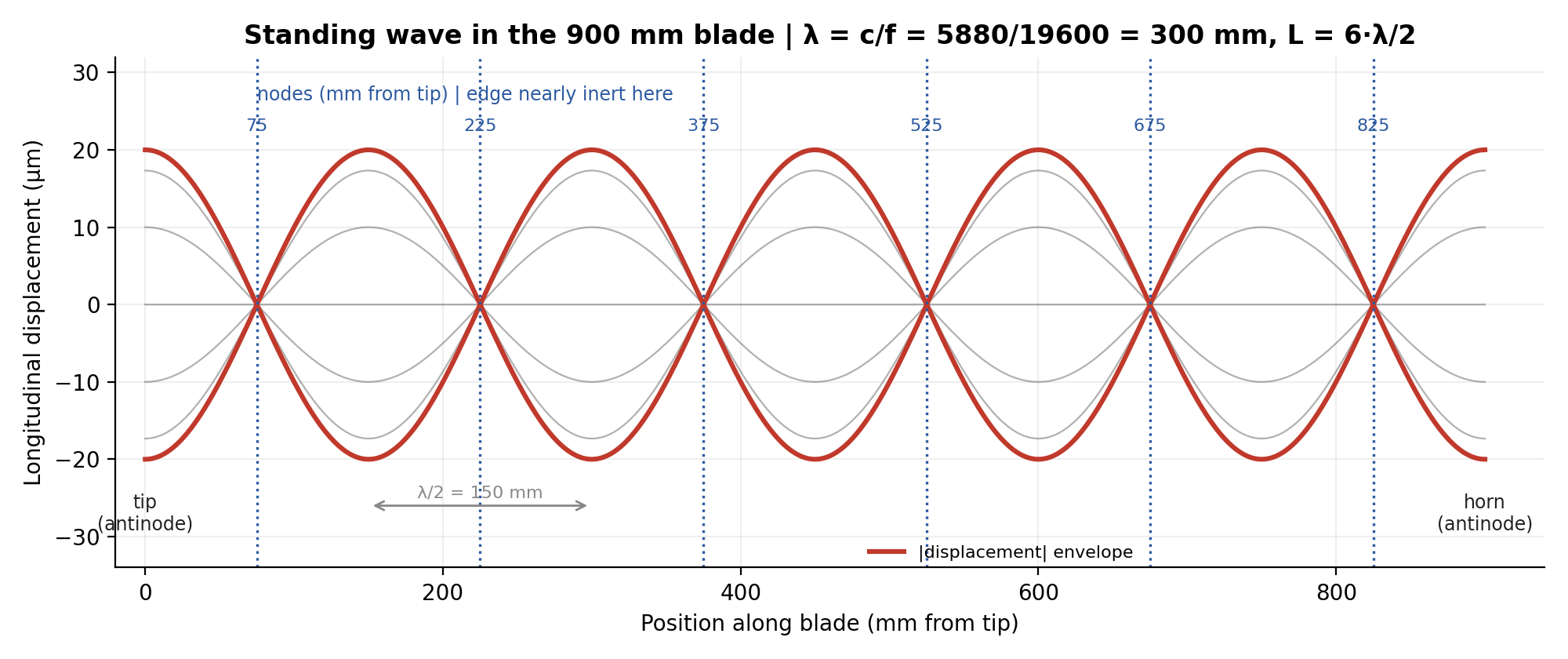
The blade is a straight, single-edged, single-fuller profile with a chisel-ground edge and a flat spine. The 900 mm active length is not arbitrary: it is exactly six half-wavelengths of the longitudinal acoustic mode at the nominal 19.6 kHz drive frequency (see Section 3).
| Parameter | Value |
|---|---|
| Active blade length (guard to tip) | 900 mm |
| Housing and grip length | 290 mm |
| Overall length | 1,190 mm |
| Blade width at ricasso | 38 mm |
| Blade width at 100 mm from tip | 24 mm |
| Spine thickness at ricasso | 7.2 mm |
| Spine thickness at 100 mm from tip | 3.1 mm |
| Edge geometry | Single chisel bevel, 11° included, 0.4 mm micro-bevel at 19° |
| Blade mass | 1.42 kg |
| Total mass, cell fitted | 2.86 kg |
| Point of balance (energised, cell fitted) | 92 mm forward of guard |
| Blade material | Proprietary martensitic alloy, designation [REDACTED]; nominal longitudinal sound speed 5,880 m/s |
| Edge inlay | Ferroelectric ceramic strip, 1.1 mm wide, full edge length (see Section 5) |
| Housing material | Carbon-fibre composite over a machined alloy spine; electrically isolated from the blade |
| Power cell | Removable, 14.8 V nominal, 2.1 kg class. Capacity rated for 11 minutes continuous full drive or roughly 40 minutes of typical intermittent engagement |
| Operating temperature (blade body) | −20 °C to +180 °C sustained; transducer stack limited to +140 °C |
The fuller is acoustically functional. It thins the central web of the blade so that the longitudinal mode dominates over flexural modes, which would otherwise waste drive energy as whole-blade whipping and make the point unpredictable. The fuller is machined to a tolerance of ±0.02 mm along its length. A blade whose fuller has been ground, polished or decoratively etched by a third party should be returned for re-tuning before use.
The spine carries a shallow dovetail along its full length. This is the mounting rail for the field-shaping electrode that forms one half of the plasma system (Section 5). It is not a decorative feature and must not be used to attach accessories.
Housing. The grip encloses the transducer stack, the acoustic horn, the drive electronics and the high-voltage pulse module. The housing is isolated from the blade at the nodal mount (Section 4), so the operator's hands rest on a surface that is, in principle, acoustically and electrically dead. In practice, see Section 9.
3. Principle of operation: resonant cutting
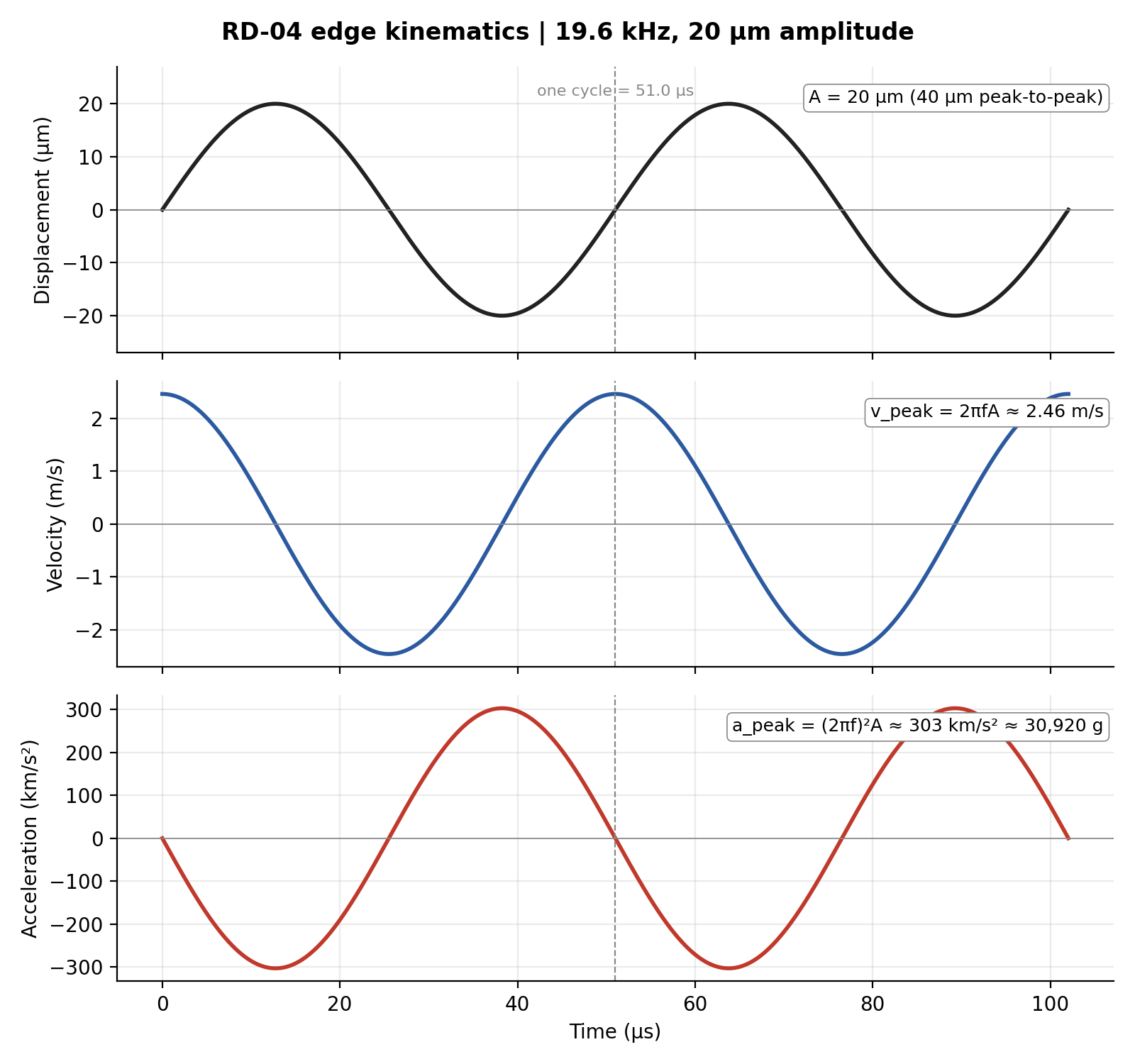
The RD-04 cuts because its edge is never still. At nominal drive the edge oscillates along the blade's long axis at 19.6 kHz with a peak-to-peak displacement of 40 µm. That motion is invisible and nearly inaudible, but its consequences at the edge are extreme.
Edge kinematics. A 20 µm amplitude at 19.6 kHz gives the edge a peak velocity of about 2.5 m/s and a peak acceleration of roughly 3 × 10⁵ m/s², a little over 30,000 g. The edge therefore strikes any surface it is pressed against nearly 40,000 times per second, each strike a microscopic impact rather than a steady push. The operator supplies direction and modest force; the drive supplies the hammering.
Three effects follow, and together they account for the blade's performance against materials that a static edge of the same geometry would never penetrate.
- Acoustic softening. A metal under intense ultrasonic vibration deforms plastically at a lower stress than the same metal at rest. The effect is well documented in ultrasonic forming and welding: the vibration supplies energy that helps dislocations move past obstacles in the crystal lattice, so the material yields earlier. At the RD-04's edge, the target material within a fraction of a millimetre of the cut is in this softened state for as long as the edge is in contact.
- Friction reduction. Because the edge is in contact with the cut face for only part of each cycle, the time-averaged friction between blade and target drops sharply. In practical terms the blade does not bind. A cut that stalls on a conventional blade when the flanks seize in the kerf continues on the RD-04, because the kerf walls are released thousands of times per second.
- High-cycle fatigue fracture. Any material with a fatigue limit is attacked at that limit rather than at its ultimate strength. The edge delivers tens of thousands of load cycles per second at the crack tip it is creating. Brittle and semi-brittle targets (ceramics, hardened steels, mineral composites) fail by crack propagation well below the force that would be needed to shear them.
Why the blade must be a resonator. Driving a 1.4 kg steel bar at 40 µm amplitude by brute force would require absurd power. Instead, the blade is cut to a length at which it rings. At 19.6 kHz, with a longitudinal sound speed of 5,880 m/s, the wavelength in the blade alloy is 300 mm; the 900 mm blade is therefore six half-wavelengths long. A standing wave forms with displacement antinodes at the tip and at the horn interface and a series of nodes along the length where the blade does not move at all. Energy stored in the standing wave is recycled each cycle, and the drive only has to replace what is lost to internal damping and to the target. At resonance, the whole blade stores roughly 200 times the energy the transducer delivers per cycle.
This is also why the weapon is sensitive to its own temperature and to damage. Sound speed in the alloy falls as the blade heats, so the resonant frequency drifts downward during sustained use; the drive electronics track this drift (Section 4), but only within a window of about ±600 Hz. A chip in the edge, a bent tip or a fatigue crack shifts the resonance further and faster than the tracking loop can follow, and the blade goes dead in the hand until it is repaired.
Dwell. Operators are trained to let the edge dwell on the target for a fraction of a second rather than to slash through. Acoustic softening and fatigue cracking are rate-dependent: they need cycles, and cycles need time. A fast slash on the RD-04 behaves much like a fast slash on a conventional blade. A deliberate push-cut with brief dwell behaves like nothing a conventional blade can do.
4. Drive system
The drive train runs from the power cell at the pommel to the edge at the tip, and every stage of it is in the grip.
Transducer stack. Motion originates in a bolt-clamped sandwich transducer: eight piezoceramic rings, alternately poled, clamped under 28 kN of pre-stress between a steel back mass and the base of the horn. A sinusoidal drive voltage across the rings makes the stack lengthen and shorten by a few micrometres per cycle. The pre-stress keeps the ceramic in compression at all times, since piezoceramic that experiences tension cracks within seconds. Continuous electrical input at full drive is 310 W; peak during a loaded cut can reach 480 W for short intervals.
Acoustic horn. The stack's few micrometres of motion are amplified by a stepped-then-exponential horn machined from the same alloy as the blade. The horn's cross-section narrows from the stack diameter to the blade's ricasso, and amplitude scales with the area ratio: a gain of 11:1 between stack face and blade root. The horn is a half-wavelength long and is therefore itself a resonant element. It is also the single most highly stressed component in the weapon; the alternating stress at its throat approaches 40 percent of the alloy's fatigue limit at nominal drive.
Nodal mounting. The blade and horn assembly is held to the housing at exactly one point: a thin flange at the horn's displacement node, where the standing wave has zero longitudinal motion. Everywhere else, the blade floats free inside the housing with a 0.6 mm clearance. This is what lets a 310 W oscillator be held in bare hands. Any contact between blade and housing away from the node drains energy, heats the housing and transmits vibration to the operator. A rattle felt in the grip is a fault, not a feature, and the weapon should be powered down.
Frequency tracking. The drive electronics do not run at a fixed 19.6 kHz. They run a phase-locked loop that measures the phase angle between drive voltage and current and adjusts frequency to keep the stack at electrical resonance, where that angle is zero. As the blade heats and its resonance drifts downward, the loop follows. Tracking range is 19.0 to 20.2 kHz. Outside that band the loop declares a fault, cuts drive to the stack and logs the event. The loop updates every 2 ms, which is fast enough for thermal drift and far too slow for mechanical damage.
Amplitude regulation. A second loop holds edge amplitude constant under varying load. When the edge bites into a dense target, the mechanical load rises and amplitude would otherwise collapse; the controller raises drive voltage to compensate, up to the 480 W ceiling. Beyond that ceiling the blade simply slows down, and the operator feels the cut "thicken". This is intentional. The alternative, letting the stack draw unlimited power, would destroy it within a few seconds of a stalled cut.
Power cell. The removable cell is a 14.8 V pack with an integral boost converter that supplies the 180 V drive rail and a separate 4.2 kV rail for the plasma pulse module (Section 5). Hot-swapping the cell is possible; the drive electronics hold enough stored charge to ride through a swap of under 3 seconds. Operators are warned that the high-voltage rail remains charged for up to 90 seconds after the cell is removed. Section 8 covers the consequences.
Thermal path. Losses in the stack, roughly 15 percent of input, must be dissipated or the ceramic will exceed its Curie temperature and permanently lose its piezoelectric properties. Heat is conducted from the back mass into the alloy spine of the housing and radiated from the pommel, which runs noticeably warm after about 4 minutes of continuous drive and uncomfortably hot after 8. The 11-minute continuous rating is a thermal limit, not an electrical one; with the cell at full charge the stack would overheat before the cell was empty.
5. Edge plasma sheath
The red glow along the RD-04's edge is an atmospheric-pressure glow discharge, roughly 0.8 mm thick, that the weapon sustains in ordinary air along the full 900 mm of edge whenever the plasma system is armed. It is the feature that separates the RD-04 from its predecessors, and it is the reason the weapon's lethality is a step above a resonant blade alone.
How it is generated. The edge carries a 1.1 mm strip of ferroelectric ceramic inlaid immediately behind the micro-bevel; the spine carries a thin field-shaping electrode in the dovetail rail. A 4.2 kV pulse train is applied between the two, so that the electric field runs across the blade's flank from spine to edge and concentrates at the edge, where the geometry is sharpest. The ceramic strip acts as a dielectric barrier: it lets the field through but blocks current, so the discharge cannot collapse into a single arc. Instead the air at the edge breaks down into a diffuse, self-limiting glow that reforms on every pulse.
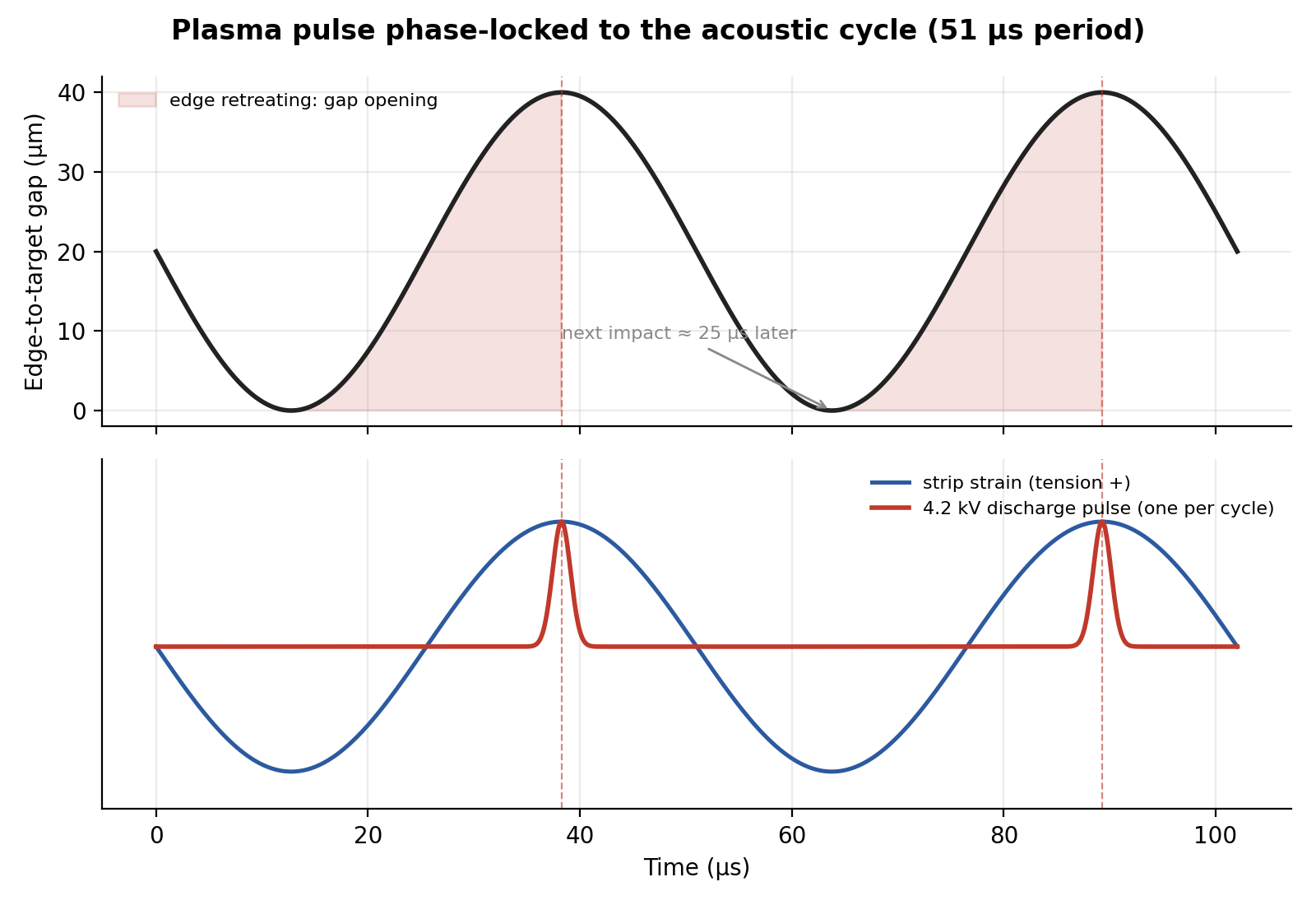
The pulse train is phase-locked to the acoustic drive. One pulse fires per mechanical cycle, timed to the half-cycle in which the edge is retreating from the target and a fresh gap is opening. This is the moment the plasma can reach the newly exposed cut face, and it is also the moment the ceramic strip is under maximum tensile strain. Ferroelectric ceramic under strain develops its own surface charge, and this piezoelectric contribution adds roughly 300 V to the applied pulse at the edge, exactly where it is needed. The two systems reinforce each other: the blade's vibration helps make the plasma, and the plasma, as described below, helps the blade cut.
Average electrical power to the plasma system is 60 W, about one fifth of the total draw. The visible sheath extends 2 to 3 mm beyond the physical edge; the electrically active region is thinner than that.
Why it is red. The colour is diagnostic, and operators are trained to read it. Air plasma can glow blue-violet or red depending on how its energy is distributed. Blue-violet emission comes from highly excited molecular nitrogen and dominates in hot, filamentary or arc-like discharges. Red emission comes from a lower-energy band of nitrogen and dominates in cool, diffuse glow discharges where most of the energy sits in vibrationally excited and metastable molecules rather than in fast electrons.
The RD-04's pulse module is deliberately tuned to hold the discharge in the red regime. The reason is that the red regime is the dangerous one. A filamentary blue discharge concentrates its energy into a few hot channels that scar the edge and leave most of the cut line untouched. The diffuse red glow coats the entire edge uniformly, and because its energy is stored in long-lived excited molecules rather than in short-lived fast electrons, that energy survives long enough to be delivered into the target surface rather than radiated away as light. A blade glowing blue is a blade in fault: either the ceramic strip has cracked, the gap to the spine electrode has shifted, or the pulse module has lost regulation. Section 9 treats blue-shift as a mandatory shutdown condition.
Why it makes the blade more dangerous. Four mechanisms are established; a fifth is suspected.
- Thermal pre-conditioning. The sheath deposits energy into the top 50 to 100 µm of any surface the edge approaches, raising its temperature by several hundred kelvin within milliseconds. Metals lose strength as they heat. That thermal softening stacks with the acoustic softening of Section 3, and the two together bring the local yield stress of hardened steel down to a fraction of its room-temperature value just as the edge arrives.
- Micro-arc pre-cracking. On conductive targets, the discharge preferentially bridges to surface asperities along the line the edge is about to follow. Each bridge is a microscopic arc that melts and re-solidifies a pit a few micrometres across. The row of pits acts as a line of pre-seeded flaws, and the ultrasonic fatigue mechanism of Section 3 propagates cracks from them far faster than from a pristine surface. Cuts through hardened plate on the RD-04 are consistently cleaner and faster than on the RD-03, which had the same resonant drive and no plasma.
- Chemical attack. Air plasma produces atomic oxygen, ozone and nitrogen oxides. These species attack polymers aggressively. Aramid, polyethylene and polycarbonate armours, which resist ultrasonic cutting because they are tough rather than brittle, lose that toughness within the sheath: the surface layer is oxidised, embrittled and cut like a ceramic. The RD-03 was known to bind in layered polymer armour. The RD-04 does not.
- Gas-film lubrication and anti-galling. The ionised layer between edge and kerf wall is a gas film that further reduces friction, and the discharge continuously ablates any target material that begins to weld to the edge. The edge stays sharp and free in the cut for far longer than a plain resonant edge, which galls and loads up within a few seconds in soft metals.
- Suspected: synchronised energy delivery. Because each pulse fires as the edge retreats, the plasma energy lands on a surface that the edge is about to strike again within 25 µs. Bench data suggest the heated layer has not had time to conduct its heat inward before the next impact, so successive cycles stack heat at the crack tip. This has not been separated experimentally from mechanism 1 and is listed as unconfirmed.
Effect on tissue. The sheath coagulates small vessels at the cut face, so wounds bleed less than their depth would suggest. They are not, for that reason, less serious. The plasma leaves a devitalised margin extending several millimetres beyond the visible wound, and the reactive species it generates are driven into that margin. Surgical debridement of RD-04 wounds is more extensive than for a conventional blade wound of the same geometry, and medical personnel receiving such casualties should be told the mechanism.
6. Performance envelope
Figures below are bench values at 20 °C ambient, full drive, plasma armed, with the edge applied by a fixture at 60 N normal force and a dwell of 0.4 s per 10 mm of cut. Hand-delivered cuts vary widely with technique; treat these as the upper bound of what a competent operator achieves.
| Target | Thickness | Mechanical cut rate | Notes |
|---|---|---|---|
| Mild steel plate | 6 mm | 180 mm/s | Clean kerf, 0.3 mm wide |
| Mild steel plate | 12 mm | 55 mm/s | Edge dwell required; cell draw near ceiling |
| Hardened armour steel | 8 mm | 40 mm/s | Fails by crack propagation; kerf face shows pre-crack pitting |
| Layered aramid, 30 ply | 18 mm | 220 mm/s | Plasma essential; RD-03 binds at this target |
| Polyethylene composite | 25 mm | 160 mm/s | Surface embrittlement visible as a white band along the kerf |
| Alumina ceramic tile | 10 mm | 95 mm/s | Fractures ahead of edge in 2 to 4 mm segments |
| Reinforced concrete | 60 mm | 30 mm/s | Rebar cut in place; aggregate shatters |
| Hardwood | 100 mm | 300 mm/s | Charring along kerf from plasma |
| Soft tissue analogue | 150 mm | Not rate-limited | Cut depth limited only by blade reach |
Where it stops working. The envelope has firm edges.
- Thickness. Beyond roughly 15 mm in steel the cut is no longer limited by edge mechanics but by debris. The kerf fills with softened material faster than the plasma can ablate it, the edge loads up and the amplitude regulator hits its power ceiling. The cut slows to a crawl and the blade heats rapidly.
- Very soft, very tough materials. Rubber, wet leather and some gel-based absorbers damp the edge rather than fracturing under it. They are cut, but no faster than by a conventional sharp blade, and they drain the cell quickly because the load never releases.
- Impact. The RD-04 is not a chopping weapon. A hard strike against a rigid target excites flexural modes, momentarily detunes the blade and can trip the frequency-tracking fault. Operators who strike with it as though it were an axe will find it dead in their hands for the 400 ms the loop needs to re-acquire. Several of the anomalies in Section 10 trace to this.
- Water. Immersion of the edge extinguishes the plasma instantly and loads the acoustic system heavily. The weapon remains a resonant blade underwater at reduced amplitude, and the high-voltage system, if armed, will attempt to re-strike continuously and waste the cell. Operating doctrine is to disarm the plasma before any wet engagement.
- Thin air. The glow discharge depends on air density. Above roughly 4,000 m the discharge spreads, dims and loses most of its surface-conditioning effect, although it remains visibly red.
Reach and leverage. The 92 mm forward balance point and 1.19 m overall length give the weapon a lever arm similar to a two-handed sword, but the operator should not use the leverage. Because cutting force is supplied by the drive, the ideal engagement is a controlled push-cut with the forward third of the blade, where edge amplitude is greatest. Amplitude falls toward the nodes; the six nodes of the standing wave sit 75 mm from the tip and then at 150 mm intervals (225, 375, 525, 675 and 825 mm), and the edge is nearly inert at each. Operators learn the node positions by feel. Cutting with a node is the most common technique error in training.
7. Operating modes and controls
All controls are on the grip and are operable by the forward hand without changing grip. There is no display. State is communicated by the edge glow, by a three-tone piezo sounder in the pommel, and by feel.
| Mode | Acoustic drive | Plasma | Edge appearance | Typical use |
|---|---|---|---|---|
| Safe | Off | Disarmed | Dark | Carry, storage, maintenance |
| Standby | Idle, 5 µm amplitude | Disarmed | Dark; faint hiss | Pre-engagement; allows instant ramp |
| Resonant | Full, 40 µm | Disarmed | Dark; audible 9.8 kHz subharmonic under load | Wet or enclosed environments; cutting where glow is undesirable |
| Full | Full, 40 µm | Armed, red | Continuous red sheath | Default engagement mode |
| Burst | Full, 40 µm | Armed, 2 s then disarm | Red, extinguishing | Cell conservation; single decisive cut |
Ramp time. From Standby to Full takes 180 ms: the acoustic loop needs about 120 ms to reach amplitude and the plasma strikes within 60 ms of the high-voltage rail arming. From Safe the ramp is 1.4 s, most of it the boost converter charging the rail. Doctrine is to carry in Standby whenever engagement is plausible.
Interlocks. The weapon will refuse to arm the plasma if the acoustic loop is not locked, since an un-vibrating edge gives the discharge nowhere to go and it would bridge directly to the spine electrode. It will also refuse to arm if edge-to-spine insulation resistance has dropped below threshold, which is the usual signature of a cracked ceramic strip or a wet blade. Both refusals are signalled by a double low tone.
The grip sensor. A capacitive sensor in the grip drops the weapon to Standby within 50 ms of losing contact with the operator's hand. A thrown or dropped RD-04 lands as a sharp blade with a residual charge on its edge strip, not as a live resonant plasma weapon. This interlock cannot be disabled at operator level.
Audible signature. The 19.6 kHz fundamental is above most adults' hearing. The 9.8 kHz subharmonic that appears under load is not, and it is loud: 95 dB at 1 m in a hard cut. In Full mode the plasma adds a continuous crackle and the sharp smell of ozone. The RD-04 is not a quiet weapon when working. It is nearly silent at Standby.
8. Hazards to operator and bystanders
The RD-04 is hazardous to the person holding it. Most of the injuries recorded in service have been to operators and their own side, not to the intended target.
Residual edge charge. The ferroelectric strip retains surface charge after the plasma is disarmed and after the cell is removed. Touching the edge of a recently used RD-04 delivers a shock in the low-kilovolt range. It is rarely dangerous in itself; it is dangerous because the reflex is to pull the hand away across the edge. Armorers discharge the edge with a grounding strap before any handling. Operators do not touch the edge, ever.
High-voltage rail. The 4.2 kV rail in the grip remains charged for up to 90 seconds after power-down. The housing is insulated, but a cracked housing is not, and a housing cracked in a fall will not necessarily look cracked. A weapon that has been dropped is treated as live for two minutes.
Ultrasound exposure. Airborne ultrasound at 19.6 kHz and 95 dB does not damage hearing directly, but the 9.8 kHz subharmonic does, and prolonged exposure to the fundamental produces headache, nausea and a sensation of pressure in the ears that persists for hours. Hearing protection is mandatory for training. Operators who conduct more than about 20 minutes of cumulative cutting per day without protection show measurable high-frequency hearing loss within a month.
Contact ultrasound. If the blade touches the operator anywhere, even flat, the ultrasound couples into tissue far more efficiently than through air. Cavitation in soft tissue causes bruising that appears hours later and is disproportionate to the apparent contact. Contact with bone is painful immediately. Resting the flat of a live blade against one's own forearm, a habit carried over from conventional blade handling, is a disqualifying error in training.
Air chemistry. The plasma generates ozone and nitrogen oxides. In open air these disperse harmlessly. In an enclosed space, 2 minutes of Full-mode operation raises ozone to a concentration that causes coughing and chest tightness, and 10 minutes approaches concentrations that are hazardous to anyone remaining in the space. Doctrine for enclosed engagements is Resonant mode (plasma disarmed) unless the target demands otherwise.
Eye hazard. The sheath is bright enough at close range to leave afterimages but is not a laser-class hazard. The real risk is the ultraviolet component of the discharge, which is significant within about 0.5 m of the edge. Operators who inspect a live edge closely without eye protection report corneal irritation within minutes. The sensation is delayed and arrives after the exposure has already happened.
Fragmentation. Brittle targets fail by fracture, and fragments leave the cut at speed. Ceramic armour in particular sheds shards at several metres per second. Eye and face protection are required when cutting ceramics, masonry or glass.
Bystander proximity. The RD-04 cuts through things that a conventional blade stops at. Operators accustomed to using a wall, a vehicle door or a piece of equipment as a backstop must relearn that assumption. The weapon does not stop at the backstop. Several serious friendly injuries in training have had this cause.
Fire. The plasma ignites fuel vapour, dust suspensions and many solid fuels on contact. The kerf in hardwood chars; the kerf in dry softwood can ignite. The weapon must not be used in Full mode where flammable atmospheres are possible.
Thrown or dropped weapon. Covered in Section 7. The grip sensor drops drive within 50 ms; the blade is then a sharp 1.4 kg bar with a charged edge, and it is still sharp.
9. Failure modes and maintenance
The RD-04 fails in characteristic ways, and most of them announce themselves before they become dangerous. Operators are trained to recognise the signs; armorers are trained to act on them.
| Symptom | Probable cause | Severity | Action |
|---|---|---|---|
| Edge glow shifts from red toward blue or violet | Cracked ceramic strip, shifted spine electrode, or pulse module out of regulation | Critical | Power down immediately. Do not re-arm. Return to armorer |
| Glow is red but patchy or confined to one region | Local contamination or micro-crack in strip | High | Disarm plasma, continue in Resonant mode if necessary, return within 24 h |
| Blade "goes dead" mid-cut and recovers within a second | Flexural excitation from impact tripped tracking | Low | Technique correction. Log if frequent |
| Blade goes dead and does not recover | Resonance outside tracking band: chipped edge, bent tip, fatigue crack, or stack overheated | Critical | Power down. Inspect edge and tip. Return to armorer |
| Vibration felt in grip | Nodal mount loosened or blade contacting housing | High | Power down. Do not use. Return to armorer |
| Pommel hot to touch within 2 minutes | Stack losses rising: ceramic degrading or pre-stress bolt relaxed | High | Power down, cool 20 min, return to armorer |
| Double low tone on arming | Interlock: acoustic unlocked or edge insulation low | Medium | Dry blade, re-attempt. If persistent, return |
| Cut rate noticeably reduced across all targets | Edge amplitude down: stack ageing or horn fatigue | Medium | Schedule amplitude check |
| Ozone smell with plasma disarmed | High-voltage leakage inside housing | Critical | Power down, remove cell, treat as live for 2 min, return |
Fatigue life. The horn and the first 150 mm of blade behind the ricasso are the life-limiting components. Both operate under alternating stress for every cycle of drive, and at 19.6 kHz a single minute of operation is 1.2 million cycles. Horn service life is rated at 400 hours of drive, after which it is replaced regardless of condition. Blades are inspected for fatigue cracking at 100-hour intervals by dye penetrant at the ricasso and by resonance signature across the whole length: a crack shifts the resonant frequency and introduces a second, weaker resonance that the test fixture can detect well before the crack is visible.
Edge maintenance. The edge is not sharpened by operators. The micro-bevel sits within 0.4 mm of the ceramic strip, and any sharpening that removes more than a few micrometres of alloy will expose or undercut the strip. Armorers re-profile the edge on a fixture that references the strip optically. Field maintenance is limited to cleaning the edge with a non-conductive solvent after the edge has been grounded.
Ceramic strip. The strip is the component most sensitive to thermal and mechanical shock. It is bonded along its full length and cannot be field-replaced; a cracked strip means a blade exchange. Causes of strip failure, in order of frequency in service: dropping the weapon on the edge, striking a hard target at speed, and immersing a hot blade in cold water.
Transducer stack. Piezoceramic loses its properties permanently if heated past its Curie point. The stack is rated to 140 °C with a thermal cutout at 130 °C. A stack that has tripped the cutout more than three times is replaced on the assumption of partial depoling, since a partially depoled stack produces less amplitude for more input and heats faster, which trips the cutout again sooner. This runaway is the usual end of a neglected weapon.
Storage. Stored with cell removed, edge grounded, in a case that holds the blade by the housing only. The blade should not rest on its edge or its tip. Humidity control matters more than for a conventional blade: moisture on the ceramic strip is the most common cause of a Standby-to-Full arming refusal in the field.
Inspection interval. Daily visual and functional check by the operator (Standby ramp, glow colour, tone pattern). 100-hour resonance signature and dye penetrant. 400-hour horn replacement and stack amplitude test. Full disassembly and strip inspection at blade exchange only.
10. Known anomalies and redacted notes
The following observations are drawn from service reports. None has an explanation endorsed by the manufacturer. They are recorded so that operators do not mistake them for faults in their own weapon, and so that armorers do not dismiss them as operator error.
Glow persistence after disarm. In roughly one weapon in forty, the red sheath persists for 1 to 3 seconds after the plasma is disarmed, fading from the ricasso toward the tip. The pulse module is confirmed off during this interval. The leading hypothesis is that the ceramic strip's own piezoelectric charge, still being generated by the running acoustic drive, is briefly sufficient to sustain a weak discharge on its own. If true, it means the edge is not fully inert in Resonant mode on these units. Affected serials are listed in [REDACTED].
Frequency "memory". Blades that have been operated hot for extended periods sometimes return to a resonant frequency 20 to 40 Hz below their factory figure after cooling, and stay there. The shift is within tracking range and does not affect function. It is consistent with a small permanent change in the alloy's elastic properties, which the manufacturer has neither confirmed nor explained. Blades showing a cumulative shift of more than 150 Hz are withdrawn as a precaution.
Edge-strip charge polarity reversal. Two weapons have been returned with the ferroelectric strip poled in the opposite direction from factory. Both had been subjected to a severe electrical event (one a lightning-adjacent strike, one undocumented). Both continued to produce a red sheath. Both showed roughly half the normal pre-cracking effect on hardened steel. Armorers are directed to check strip polarity after any electrical incident.
Operator-reported "pull". A persistent minority of operators report that the blade feels as though it is being drawn into certain targets, most often hardened steel and ceramics, with the sensation strongest just before the cut begins. Bench fixtures do not reproduce any attractive force. The most likely explanation is proprioceptive: the sudden release of resistance as acoustic and thermal softening take hold within a few milliseconds of contact is read by the hand as a pull. This is noted because operators who are not warned about it tend to over-correct and lift the edge off the target at exactly the wrong moment.
Variant designations. Housings have been recovered bearing the markings RD-04/L and RD-04/S. The /L housing is 40 mm longer and contains an unoccupied bay with a connector of unknown pinout. The /S housing is standard length but its spine electrode rail extends 60 mm further toward the tip. Neither variant appears in any documentation available at this level. Both function as standard RD-04 weapons. Both are to be reported if encountered.
Redacted. Three further anomaly entries have been removed from this revision at the direction of [REDACTED]. Their serial references remain in the armorer's database under the same numbering. Operators who find their weapon's serial flagged against anomaly entries 6, 7 or 8 should surrender it for inspection without attempting to operate it.
End of dossier. Revision 4.2. Previous revisions are superseded and should be destroyed.
Gallery