Operator file · SROD
EL-3 · Electromagnetic Ranged Weaponry
EL-3 "GOD'S HAND"
Electromagnetic Launcher (Railgun)
Lore
EL-3 Portable Electromagnetic Launcher: Technical Dossier
Document control
Designation: EL-3 Portable Electromagnetic Launcher, Infantry Pattern Document class: Technical Dossier, Operator and Armorer Reference Revision: 2.6 (supersedes 2.5; changes to Sections 4, 9 and 11) Distribution: Restricted to certified EL-series armorers and cleared operators. Reproduction, excerpting or transcription without authorisation is prohibited.
Manufacturer identity, production lot codes, point of origin, procurement channel, pulse-module chemistry and all personnel names have been redacted at source and appear in this document as [REDACTED]. Redactions are permanent and cannot be reversed by any requesting party at the operator level.
Reader notice. This dossier describes a weapon whose energy store remains lethal with no round chambered and no trigger pressed. Sections 9 and 10 are mandatory reading before handling. Nothing in this document is a substitute for certified in-person instruction.
1. Overview
The EL-3 is a two-hand, shoulder-fired electromagnetic launcher that accelerates an 18 g projectile to 1,800 m/s along a 1.2 m pair of rails using a single current pulse of roughly 330 kA. It is not a rifle with a battery attached. It is a pulsed-power machine that happens to be shaped like one, and the shape is the only thing about it that a rifleman will find familiar.
The designation breaks down as follows. "EL" denotes the Electromagnetic Launcher family, in which the projectile is driven by the magnetic force on a current-carrying armature rather than by expanding gas. "3" is the third infantry-pattern iteration. EL-1 and EL-2 were crew-served and tripod-mounted; the EL-3 is the first to bring the mass and recoil within the limits of a single standing operator, and most of the engineering described in this dossier exists to achieve that.
The weapon trades almost everything a conventional rifle does well for two things a conventional rifle cannot do: a muzzle velocity nearly twice that of any chemical small arm, and a projectile that is a solid tungsten rod with no case, no primer and no propellant. The consequences are a flat trajectory, very short time of flight, armour penetration far beyond its calibre, and a logistics footprint of inert slugs and electrical charge. The costs are mass, a low sustained rate of fire, a hard limit on shots per energy cell, a rail bore that wears out, and a set of hazards to the operator that have no equivalent in conventional small arms.
Scope of this dossier. Sections 2 through 8 describe the weapon as built. Sections 9 and 10 describe what it does to people and to itself when things go wrong. Section 11 collects observations from service that the manufacturer has not explained and that operators should treat as unresolved.
2. Physical specification
The EL-3 is a bullpup layout: the rails run the full length of the weapon, the pulse module sits behind the grip against the operator's shoulder, and the energy cell hangs beneath it. Nearly 60 percent of the mass is in the rear third, which is what makes a 1.2 m barrel controllable from the shoulder.
| Parameter | Value |
|---|---|
| Rail length (breech face to muzzle) | 1,200 mm |
| Overall length | 1,340 mm |
| Bore | 15 mm square, 1 mm corner radius |
| Mass, no cell, no magazine | 14.8 kg |
| Mass, cell and 10-round magazine fitted | 17.3 kg |
| Centre of mass (loaded) | 110 mm forward of the grip |
| Rail material | Copper-chromium-zirconium alloy, hard drawn, with a replaceable bore liner of [REDACTED] refractory composite |
| Rail cross-section | 15 mm bore face, 22 mm deep |
| Rail containment | Filament-wound carbon and glass composite overwrap, 18 mm wall, pre-tensioned |
| Insulators (between rails) | Glass-ceramic, 15 mm, replaceable |
| Pulse module | Sealed, 9.6 kg, 95 kJ stored at full charge, 11 kV charge voltage |
| Energy cell | Removable, 2.4 kg, 1.4 MJ usable; 12 full-energy shots per cell |
| Magazine | 10-round, projectile and armature pre-assembled |
| Recoil system | Hydraulic buffer, 60 mm stroke, with sliding rail-and-module assembly |
| Operating temperature | −30 °C to +50 °C ambient; rail bore limited to +250 °C |
The rails are the barrel. There is no separate barrel tube; the two copper-alloy rails and the two glass-ceramic insulators between them form the square bore directly, and the composite overwrap holds the four pieces together against the magnetic force that tries to blow them apart on every shot (Section 5). A conventional rifle barrel is a pressure vessel. The EL-3 barrel is a pressure vessel in which the pressure is magnetic and acts only on the rails.
The pulse module is sealed and is not opened at any level below the manufacturer. It is handled as a single unit and exchanged as a single unit. Its chemistry and construction are redacted; its performance figures are not, and they are given in Section 4.
Furniture. The forward grip is also the forward recoil stop: the entire rail and module assembly slides 60 mm rearward in the chassis on firing, and the operator's forward hand holds the chassis, not the barrel. Gripping the barrel shroud directly, as a rifleman naturally does, puts the hand in the path of the recoiling assembly. Section 9 covers the injuries this has caused.
Sights. An electronic optic with a laser rangefinder is standard and is necessary rather than optional, because the trajectory is so flat that the holdover habits of conventional marksmanship are actively wrong (Section 7). The optic is powered from the energy cell and shares its data bus with the fire-control electronics.
3. Principle of operation
The EL-3 pushes its projectile with a magnetic field, and the field is made by the same current that flows through the projectile. There is no other energy conversion in the launch. Everything else in the weapon exists to deliver that current, survive it, and recover from it.
The circuit. The two rails are connected to the pulse module at the breech. The armature, a block of aluminium alloy carried behind the projectile, bridges the two rails and completes the circuit. When the module discharges, current flows down one rail, across the armature, and back up the other rail. The current in the rails produces a magnetic field in the bore behind the armature; the current in the armature, sitting in that field, experiences a force along the bore, away from the breech. The force acts on the armature, the armature pushes the projectile, and both leave the muzzle together.
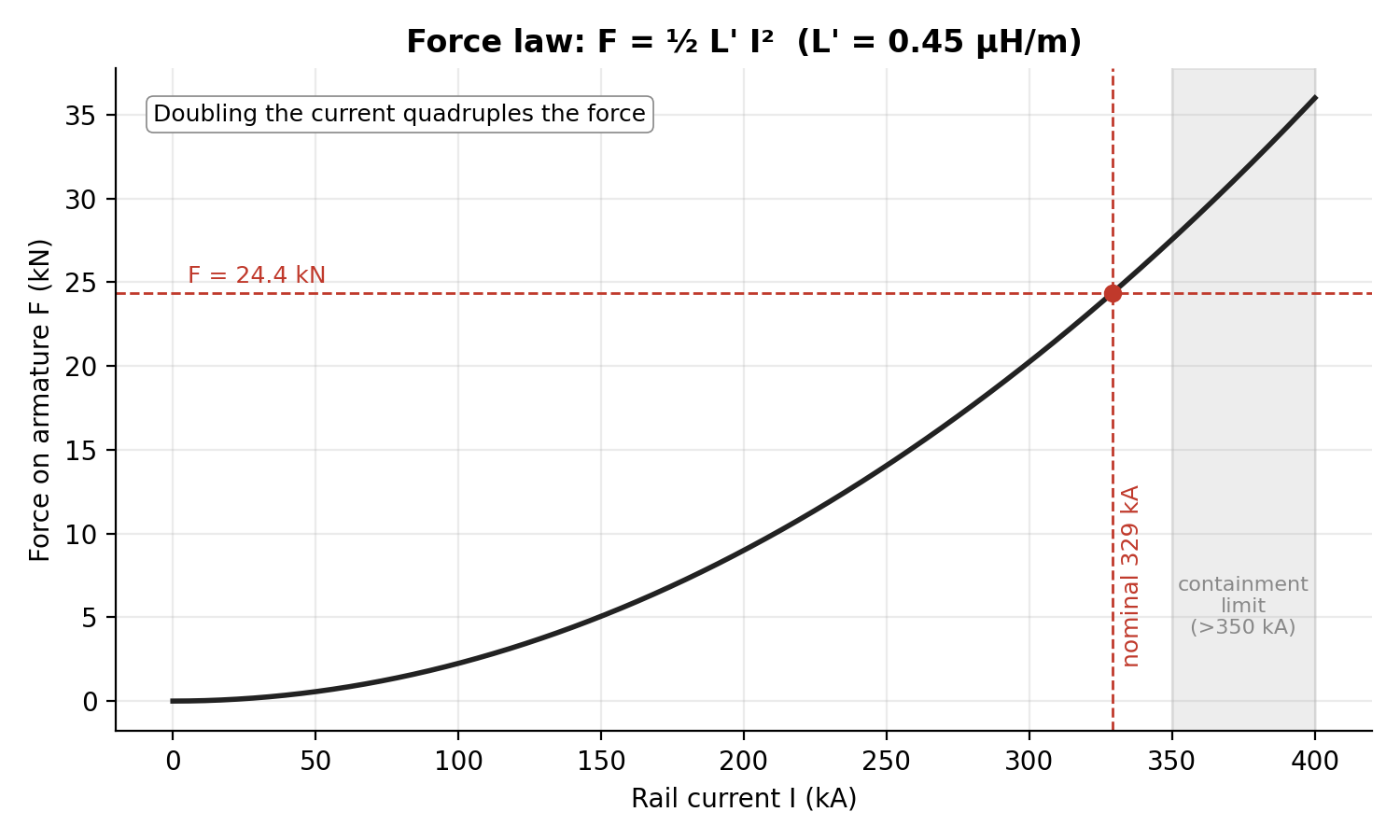
The force law. For a railgun the force on the armature depends only on the current and on a single geometric property of the rails, the inductance gradient, written L'. The inductance gradient is how much the circuit's inductance grows per metre the armature travels, and for a bore of this size it is about 0.45 microhenries per metre.
The square matters. Doubling the current quadruples the force, and nothing about the rails or the projectile changes that. It is why the EL-3 runs at 330 kA rather than at a current a conventional conductor would find comfortable, and why every component in the current path is sized for a single violent pulse rather than for steady operation.
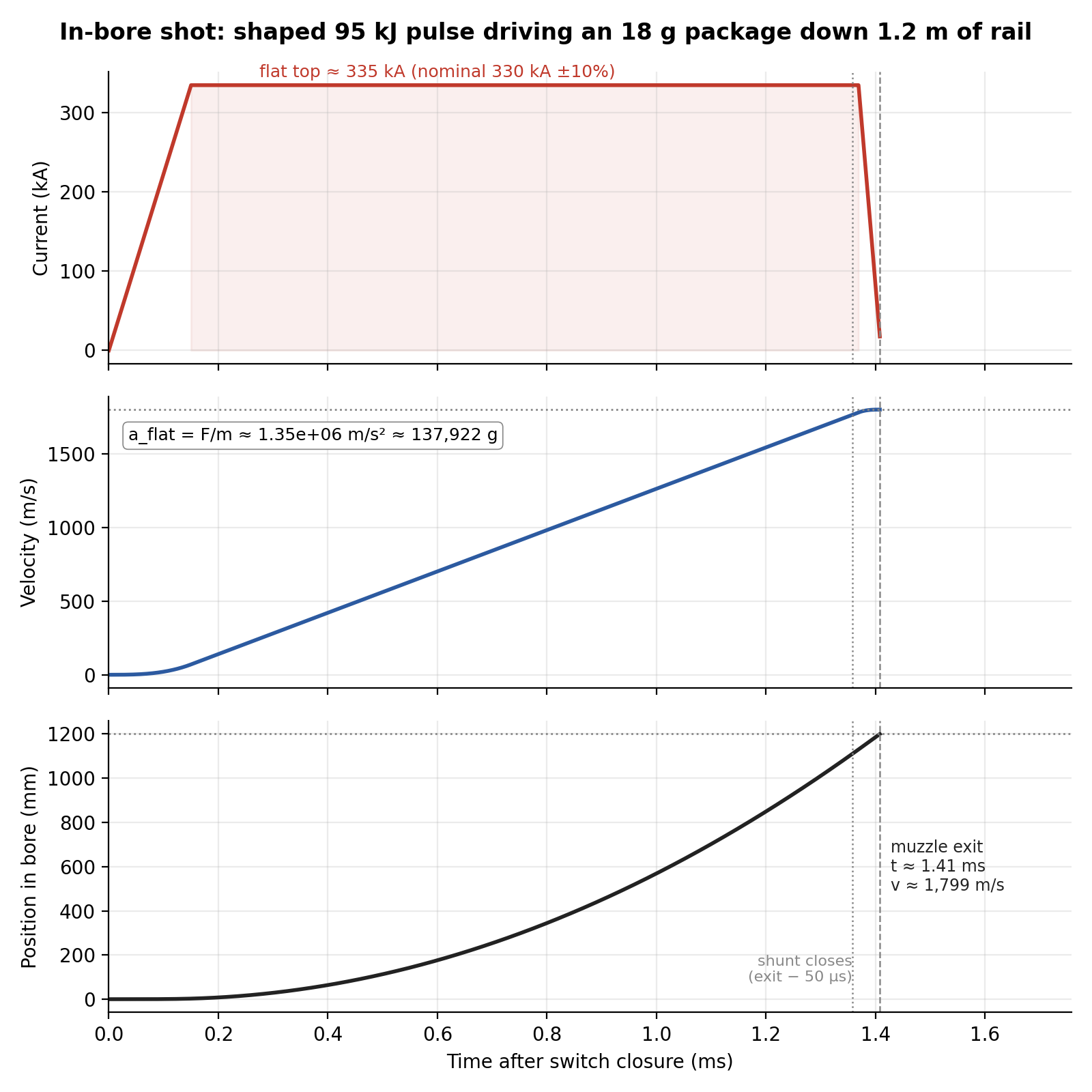
The numbers at nominal drive. With L' = 0.45 µH/m and a peak current of 329 kA, the force on the armature is about 24 kN. Acting on the 18 g projectile and armature package, that is an acceleration of roughly 1.36 × 10⁶ m/s², or about 138,000 g. Over the 1.2 m rail length the package reaches 1,800 m/s and leaves the muzzle 1.3 ms after the pulse begins.
In practice the current is not constant; the pulse module is shaped to deliver a flat-topped pulse for most of the bore transit, and the figures above are the flat-top values. The real acceleration profile rises over the first 150 µs, holds near the figures above, and tails off over the last 100 mm of rail as the module's stored energy runs down.
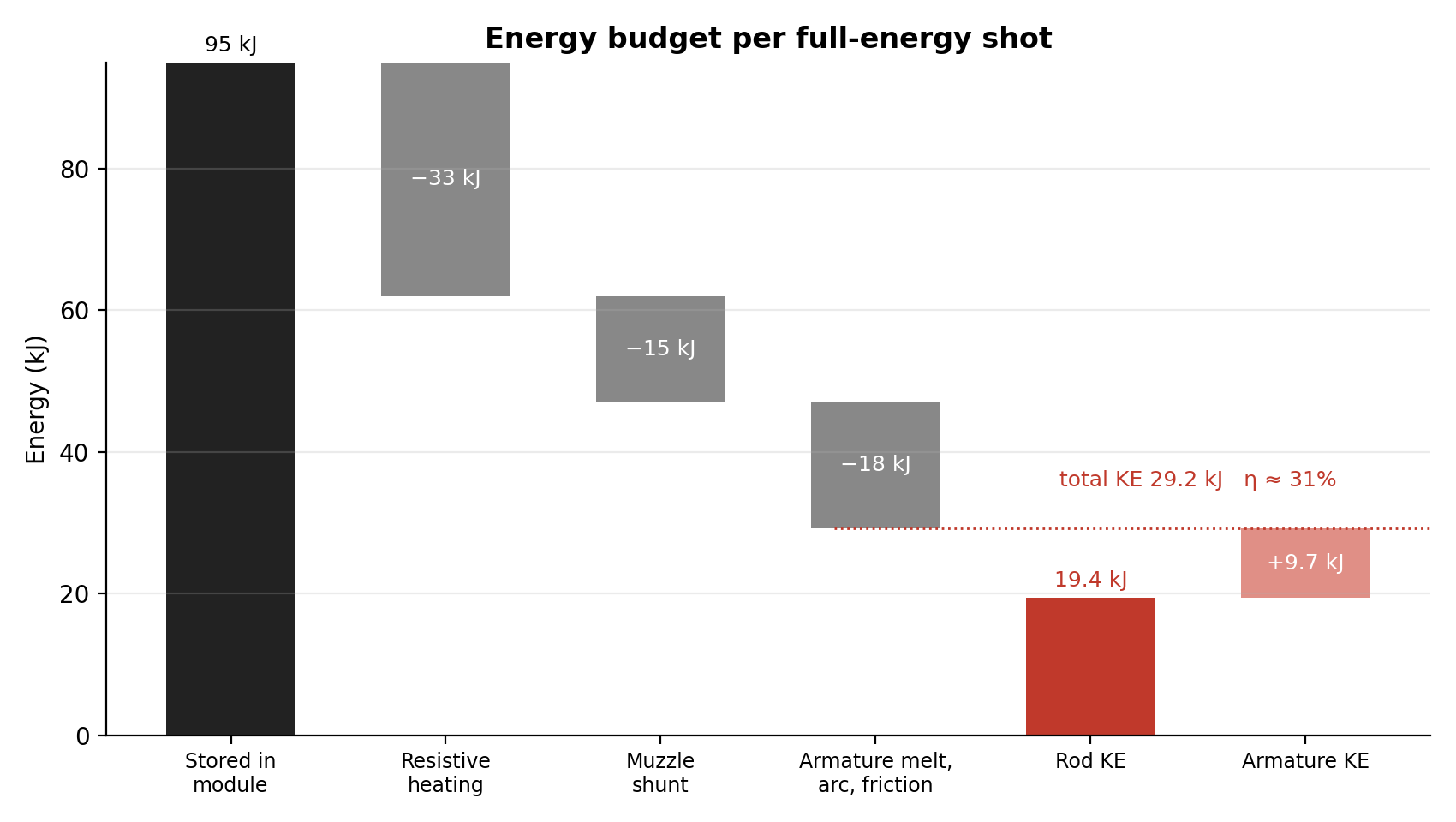
Energy. The projectile package leaves the muzzle with about 29 kJ of kinetic energy. The pulse module delivers 95 kJ. The remaining 66 kJ is lost: roughly half to resistive heating in the rails, armature and module, a quarter to the magnetic field left in the rails at the instant the armature exits (which is dissipated in the muzzle shunt, Section 4), and the rest to armature melting, arcing at the contacts, and friction. The 31 percent launch efficiency is good for a railgun of this size and is the single figure that most constrains the weapon's mass, rate of fire and shots per cell.
Why not simply push harder. Three things set the ceiling. Above about 2,000 m/s the aluminium armature begins to lose solid contact with the rails and transitions to a plasma contact that gouges the bore (Section 5). Above about 350 kA the magnetic pressure between the rails exceeds what the composite overwrap can hold through a service life of several hundred shots. And every increase in muzzle energy is paid for at 31 percent efficiency from a module whose mass is already more than half the weapon. The EL-3 is set at 1,800 m/s because that is where these three limits meet, not because the physics stops there.
4. Pulsed power system
The pulse module is the weapon. The rails are a consumable it fires through. The module stores 95 kJ at 11 kV, releases it in a shaped pulse of about 1.5 ms, and recharges from the energy cell in just under a minute. At 9.6 kg it carries roughly 10 kJ per kilogram, which is well beyond conventional film capacitors; the storage chemistry is redacted and armorers are not to speculate on it in writing.
Charge. The energy cell supplies a nominal 48 V. A boost converter in the module raises this to the 11 kV charge rail and charges the storage bank at a regulated 2 kW. A full charge from empty takes 48 s. A partial top-up after a shot, which is the normal case, takes the same time per unit of energy: the module does not charge faster when it is nearly full. The converter's switching is audible as a rising whine that ends in a click when the bank reaches set voltage; operators learn to read the pitch as a charge gauge.
Discharge switching. The bank is connected to the rails through a stack of solid-state switches rated for the full 330 kA pulse. The switches close in under 2 µs on the fire command. They cannot be opened against current; once the pulse has started, it runs to completion. There is no way to abort a shot after the trigger breaks, and operators are trained accordingly. The switch stack is the second most expensive component in the weapon after the module itself and is replaced as a unit.
Pulse shaping. A single capacitor bank discharged into the rails would deliver a sharp peak and a long tail, wasting energy at both ends. The module is divided into six sub-banks that are triggered in sequence over the first 400 µs of the shot, so that the current rises quickly to about 330 kA, holds within 10 percent of that value for roughly 900 µs while the armature travels most of the bore, and then falls as the last sub-bank runs down. The flat top is what the formulas in Section 3 assume. A sub-bank that fails to trigger produces a visibly low-velocity shot and is logged as a fault.
Muzzle shunt. When the armature leaves the rails the circuit is broken while current is still flowing, and the energy stored in the rails' magnetic field has nowhere to go. Left alone it would strike an arc from rail to rail across the muzzle, erode the rail ends and throw molten metal forward. The EL-3 closes a shunt switch across the breech end of the rails about 50 µs before predicted armature exit, giving the current a path that bypasses the muzzle. The shunt absorbs roughly 15 kJ per shot and is the hottest component in the weapon after a string of fire. Shunt timing is derived from the module's current waveform, not from a muzzle sensor, so a projectile that is slower than expected (worn rails, cold armature) exits after the shunt has closed and some current is lost; one that is faster exits before, and a muzzle arc occurs. Section 10 covers both cases.
Energy cell. The cell is a 2.4 kg pack with 1.4 MJ usable, enough for 12 full-energy shots with the charging losses accounted for. A fresh cell cannot fire until the module has completed one full charge cycle, so the first shot after a cell change is 48 s away. Cells are hot-swappable; the module retains its charge during a swap, so a loaded weapon with a fresh cell fitted is ready to fire immediately if it was charged before the swap.
Stored energy hazard. A fully charged module holds 95 kJ at 11 kV. This is roughly the chemical energy of 20 g of high explosive, or five times the muzzle energy of a heavy anti-materiel rifle round, held in a sealed box the size of a large dictionary and released in a millisecond if the wrong thing touches the wrong terminal. The module cannot be made safe by removing the cell. It can only be made safe by discharging it, either by firing or by the bleed circuit, which takes 14 minutes to bring the bank below 50 V. A module that has been removed from a weapon while charged is a charged module, and is handled as one. Section 9 covers the consequences.
Thermal. Roughly 20 kJ per shot is dissipated inside the module. The module's thermal mass holds this well for a few shots, but a string of six shots in two minutes raises the internal temperature enough to trip the thermal lockout, and the module will not accept a charge command until it has cooled. In warm weather, with the module shaded, this takes about eight minutes. In direct sun it can take twenty.
5. Rails, armature and bore
The rails carry 330 kA for 1.5 ms, are pushed apart by their own magnetic field with a force exceeding a meganewton per metre, and are rubbed along their full length by a block of aluminium moving at up to 1,800 m/s. They are the component that wears out. Everything in this section is about making them wear out slowly.
Rail material. The rails are a copper-chromium-zirconium alloy chosen for the best available compromise between conductivity and strength at the temperatures the bore reaches. Pure copper conducts better but softens and gouges; harder alloys resist gouging but run hotter and lose more energy. The bore face carries a replaceable liner of a refractory composite whose composition is redacted. The liner is 1.2 mm thick, is bonded to the rail, and is the part that is actually replaced when an armorer "re-rails" a weapon.
Containment. Two parallel conductors carrying current in opposite directions repel. At 330 kA with a 15 mm separation the repulsive force exceeds 1.4 MN per metre of rail, which over a 1.2 m barrel is a total of about 1.7 MN, the weight of roughly 170 tonnes, trying to split the barrel lengthwise for the duration of each pulse. The composite overwrap is filament-wound under tension so that the rails and insulators are in compression at rest and remain in compression at peak current. A barrel whose overwrap has been cut, drilled, scorched or impact-damaged is not a barrel. It is a device for throwing rails sideways on the next shot.
The armature. The armature is a C-shaped block of aluminium alloy, 6 g, that sits behind the projectile and bridges the two rails. Its trailing arms are sprung outward so that it presses against the rails before any current flows; once current flows, the magnetic force pushes the arms harder against the rails and the contact improves as the current rises. The armature is designed to run as a solid metal contact for the whole bore transit. At 1,800 m/s it just manages this. The surfaces in contact melt to a depth of a few micrometres and ride on a film of liquid aluminium, which is why the bore is coated in a thin aluminium wash after every shot.
Transition. If the armature loses solid contact, the current jumps the gap as an arc, the arc becomes a plasma brush, and the plasma brush erodes the rail face far faster than the solid contact did. This event is called transition, and avoiding it is the reason the EL-3 is held to 1,800 m/s. Transition becomes likely above about 2,000 m/s, when the armature arms can no longer be held against the rails by spring and magnetic force together, and it becomes certain if the bore is worn, dirty, or carrying an armature that has been damaged in the magazine. A shot that transitions is audible as a louder, sharper report with a visible white-violet flash at the muzzle, and leaves a characteristic pitted track along the rails.
Erosion and life. In normal operation each shot removes a few micrometres of liner. The manufacturer rates the liner for 300 shots before re-railing; service experience is 220 to 280 depending on climate, cleaning discipline and how many shots have transitioned. A single transitioned shot can consume the equivalent of 15 to 20 normal shots of liner life. Rail wear is not uniform: it concentrates in the first 200 mm of bore, where current is highest and the armature is slowest, and at the muzzle, where the shunt timing is never perfect.
Bore cleaning. The aluminium wash must be removed after every string of fire. Left in place it alloys with the liner surface on the next shot and creates high-resistance spots that seed transition. Cleaning is by a pull-through swab with the specified solvent, followed by a dry pull-through. No abrasives. No metal brushes. A brass brush, standard issue for conventional small arms, leaves brass deposits that are worse than the aluminium it removes.
The insulators. The two glass-ceramic insulators that form the other two bore faces carry no current but take the same mechanical abuse as the rails and are additionally exposed to the aluminium plasma if a shot transitions. They are replaced with the liners and should be inspected for tracking marks, which are the thin dark lines that an arc leaves across an insulator surface and which, once present, make the next arc more likely to follow the same path.
6. Projectile and terminal effects
The EL-3 fires a 12 g tungsten-alloy rod, 5 mm in diameter and 35 mm long, with no case, primer, propellant or driving band. The rod is inert. It can be carried loose in a pocket, dropped, wetted or frozen without consequence, and it is the only part of the ammunition that reaches the target.
The round. A complete round is the rod seated in the 6 g aluminium armature described in Section 5, held by a light friction fit. Rounds are supplied pre-assembled in 10-round magazines and are not disassembled or reassembled in the field. A rod that has been separated from its armature is not fired; a damaged armature is the most common cause of transition, and the damage is rarely visible.
Separation. The armature and rod leave the muzzle together at 1,800 m/s. The armature, which is light, blunt and partly molten, decelerates violently in air and falls away within the first two metres, usually in two or three pieces. The rod continues alone. The armature fragments are a hazard to anyone standing to the side of and slightly forward of the muzzle (Section 9), and they are the reason the EL-3 has a forward muzzle shroud that a conventional rifle would not need.
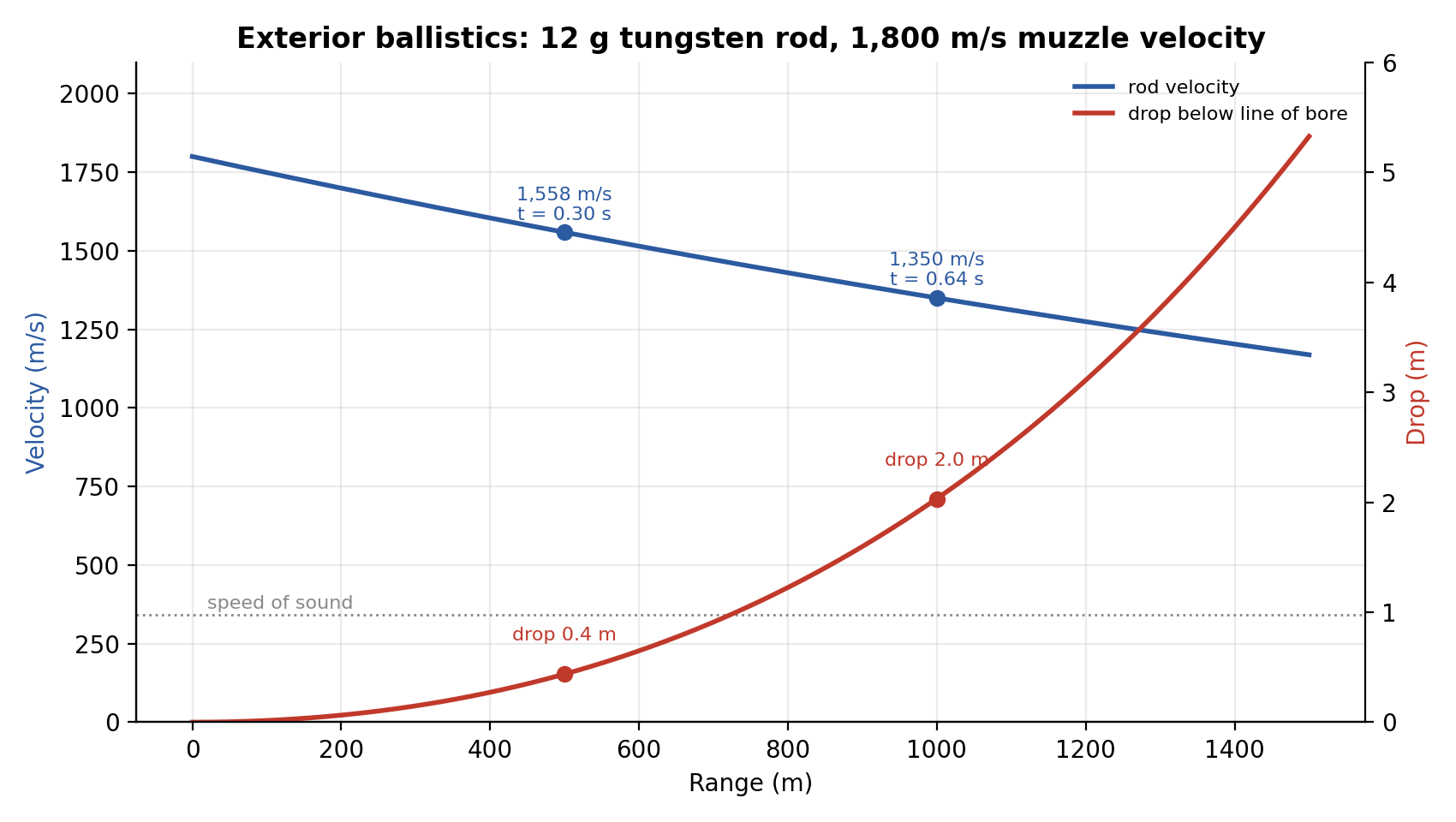
Exterior ballistics. At 1,800 m/s the rod has a sectional density far higher than any conventional small-arms projectile, and it loses velocity slowly. It remains supersonic to beyond 1,500 m and arrives at 1,000 m still travelling at roughly 1,350 m/s. Time of flight to 500 m is 0.31 s; to 1,000 m, 0.64 s. Drop at 500 m is about 0.5 m, and at 1,000 m about 2 m. Compared with a conventional rifle these figures are close to a straight line, and operators retrained from conventional weapons consistently shoot high at medium range because they apply holdover that is not needed. The rangefinding optic corrects for this; marksmanship instinct does not.
Terminal effects against armour. The rod is a long-rod penetrator in miniature. At the velocities involved it does not punch a hole in the way a bullet does; it erodes its way through the target while the target erodes it, and the depth of penetration is set by the rod's length and density and by the target's density and strength. Against rolled homogeneous armour the EL-3 rod penetrates about 25 mm at 100 m and about 20 mm at 500 m. Against ceramic-faced composite armour, which defeats conventional rifle rounds by shattering them, the rod's length and velocity carry it through the ceramic and into the backing, and penetration is better than the steel figure would suggest. Against spaced or sloped armour performance falls off quickly, because the rod yaws after the first plate and strikes the second sideways.
Terminal effects against materiel. Engine blocks, transmission housings, light armoured vehicle hulls, radar and optical equipment, and structural steel to about 20 mm are all defeated at practical ranges. The rod leaves a small entry hole and a large spall cone on the far side of any brittle or laminated target. Fuel and ordnance behind the plate are at risk from the spall and from the rod itself, which arrives hot.
Terminal effects against personnel. The rod is not designed for use against personnel, and against an unarmoured target it is in some respects less effective than a conventional rifle round: it is small in diameter, it does not deform or fragment, and it frequently passes through without yawing. A hit is nonetheless catastrophic at the point of impact because of the energy involved, and the rod does not stop at the first person, the first wall, or often the second. Section 9 covers the backstop problem. Against body armour of any rating in current use the rod is not stopped.
Signature. There is no propellant flash and no propellant smoke. There is a bright, brief white-violet flash at the muzzle from the aluminium armature as it exits and begins to oxidise, a sharp report from the air displaced by the projectile package, and the crack of the rod going supersonic, all within a few milliseconds. The combined sound is louder than a conventional rifle of similar energy and has a distinctive snap rather than a boom. It is readily identifiable to anyone who has heard it before. A shot that has transitioned (Section 5) is noticeably louder and the flash is larger and longer.
7. Performance envelope
Figures below are bench values at 20 °C ambient, new liner, full-energy shot, armature from a sealed magazine. Field performance degrades with liner wear, bore contamination and module temperature, in that order of importance.
| Parameter | Value |
|---|---|
| Muzzle velocity, new liner | 1,800 m/s (±25 m/s shot to shot) |
| Muzzle velocity, liner at 250 shots | 1,720 m/s typical |
| Muzzle energy (rod only) | 19.4 kJ |
| Muzzle energy (rod and armature) | 29.2 kJ |
| Recoil impulse | 32 N·s |
| Effective range, point target (vehicle-sized) | 1,200 m |
| Effective range, point target (man-sized) | 800 m |
| Maximum range | 4,500 m, rod tumbling |
| Penetration, RHA, 100 m | 25 mm |
| Penetration, RHA, 500 m | 20 mm |
| Penetration, RHA, 1,000 m | 14 mm |
| Cyclic rate, module at full charge | 2 shots in 4 s (one from bank, one from reserve) |
| Sustained rate, module charging | 1 shot per 48 s |
| Sustained rate, thermal limit | 6 shots per 10 min, then lockout |
| Shots per energy cell | 12 at full energy; 19 at reduced-energy setting |
| Liner life | 300 shots rated; 220 to 280 in service |
Recoil. The 32 N·s impulse is similar to a heavy anti-materiel rifle. Without the recoil system it would arrive in 1.3 ms and break the operator's collarbone. The sliding rail-and-module assembly and the hydraulic buffer spread it over about 60 ms, which brings peak force on the shoulder down to a level a trained operator tolerates from the standing position for a few shots and from a supported position indefinitely. Firing from the hip is prohibited: the recoil stroke is aligned with the barrel, and the chassis rises sharply if the stock is not braced.
Where it stops working.
- Rate of fire. The EL-3 is a two-shot weapon followed by a long pause. The reserve sub-bank allows one immediate follow-up; after that the operator waits 48 s. Doctrine treats it as a precision weapon with a second chance, not as a repeating rifle.
- Heat. Six full-energy shots in ten minutes trips the module's thermal lockout. The rails reach the same limit at about the same point. In hot weather both margins shrink. A weapon that has been firing hard for twenty minutes is a weapon that cannot fire for ten.
- Liner wear. Velocity falls slowly and then quickly. The last 50 shots of a liner's life produce increasingly scattered velocities, and the final shots before an armorer condemns the liner are often 100 m/s slow. The optic's ballistic solution assumes the nominal velocity, so a worn weapon shoots low at range.
- Cold. Below −10 °C the armature alloy stiffens and the sprung arms press less firmly against the rails before current flows. Transition probability rises. Doctrine is to keep magazines inside clothing in cold weather and to load from a warmed magazine.
- Water in the bore. A bore with standing water in it will flash the water to steam on firing. The steam has nowhere to go but out the muzzle, past the armature, and it strips the aluminium wash into the rail contact. The shot usually completes but transitions. The bore is swabbed dry before firing after rain, immersion, or condensation.
- Electromagnetic environment. The firing pulse produces a strong, brief electromagnetic disturbance (Section 9). The weapon itself is hardened against it, but the optic's rangefinder is blind for about 200 ms after each shot, which is long enough to matter for a fast second shot at a moving target.
Reduced-energy setting. The fire-control electronics allow the operator to select a 60 kJ shot, which fires at about 1,450 m/s. Penetration falls to roughly 16 mm RHA at 100 m. Shots per cell rise to 19, module heating falls by a third, liner wear falls by about half, and recoil is noticeably softer. Doctrine prefers this setting for anything that does not need the full-energy shot, and most operators leave it there.
8. Operating modes and controls
All controls are on the grip and the chassis and are operable without changing the firing grip. State is communicated by the optic's display, by a three-tone sounder in the stock, and by the charging whine from the module.
| Mode | Module | Rails | Sounder | Typical use |
|---|---|---|---|---|
| Safe | Bleeding to below 50 V (14 min) or held at residual | Open circuit, shunt closed | Single low tone on entry | Transport, storage, maintenance |
| Hold | Charged, switches locked out | Open circuit, shunt closed | Silent | Carry with a round loaded; ready in under 1 s |
| Armed | Charged, switches enabled | Open circuit, shunt open | Short high tone | Immediate engagement |
| Reduced | As Armed, 60 kJ pulse | As Armed | Two short high tones | Default for most targets |
| Charging | Converter running | Open circuit, shunt closed | Rising whine, click at set voltage | Automatic after each shot |
Ready time. From Hold to a fired shot takes under one second: the switch lockout releases in 400 ms and the trigger is live. From Safe with the module bled, the weapon needs a full 48 s charge before it can fire, and a further 48 s before the reserve sub-bank is available for a second shot. Doctrine is to carry in Hold whenever engagement is plausible and to accept the stored-energy hazard that implies.
Loading. The magazine feeds a complete round (rod and armature) into the breech when the charging handle is cycled. The breech block closes behind the armature and makes the electrical connection between the module terminals and the rails. A round that is not fully seated is detected by a continuity check across the armature, and the weapon refuses to arm with a single low tone. Operators do not clear this fault by forcing the charging handle; the usual cause is a deformed armature, and forcing it seats a round that will transition.
Firing. The trigger is a two-stage electronic switch. First stage confirms the round is seated and the shunt is open; second stage fires. There is no mechanical connection between the trigger and anything that moves. There is no half-cock, no decocking, and no way to lower a hammer. A round in the breech of an Armed EL-3 is one trigger pull from firing and nothing else.
Interlocks. The weapon will not fire with the shunt closed, with the breech block open, with the module below 55 kJ, with the module above its thermal limit, or with the bore sensor reading a liner temperature above 250 °C. It will fire with a wet bore, a worn liner, a cold armature or an operator who has not braced the stock. None of these can be sensed, and none is the weapon's problem.
Grip sensor. A capacitive sensor in the grip drops the weapon from Armed to Hold within 100 ms of losing contact with the operator's hand. A dropped EL-3 lands with a charged module, a round in the breech and its switches locked out. It does not fire. It remains, as Section 9 explains, dangerous.
Audible signature at rest. A charged EL-3 in Hold is silent. A charging EL-3 is not: the converter whine is audible at 30 m in quiet conditions and is a known tactical liability. Operators are trained to charge during movement or under cover of other noise, and the fire-control software allows the recharge to be deferred to a manual command for this reason.
9. Hazards to operator and bystanders
The EL-3 is hazardous to the person holding it and to everyone near them. Most of the injuries recorded in service have been to operators and their own side, and most have involved the pulse module rather than the projectile.
Stored energy. A charged module holds 95 kJ at 11 kV behind a sealed case. The case is insulated. A cracked case is not, and a case cracked in a fall will not necessarily look cracked. Contact with an exposed terminal is not survivable. The module cannot be made safe by removing the energy cell; it can only be bled (14 minutes) or fired. A weapon that has been dropped is placed in Safe and left untouched for the full bleed cycle before it is examined, and a module that has been removed from a weapon is treated as charged until an armorer has measured it, regardless of what anyone says about its history.
Electromagnetic pulse. The firing current rises from zero to 330 kA in about 150 µs. The magnetic field this produces around the rails and the module is brief and intense, and it induces damaging voltages in nearby electronics. Unshielded radios, night optics, medical devices and personal electronics within about 3 m of the weapon are at risk of permanent damage on every shot. Pacemakers and implanted defibrillators within 5 m are at risk of malfunction. The weapon's own electronics are hardened; nothing carried by the operator or the people beside them is. Personnel with implanted medical devices do not serve on EL-3 crews and are kept outside the 5 m line.
Magnetic attraction. For the duration of the pulse the field near the rails is strong enough to move ferrous objects. Loose steel items within about half a metre of the barrel, including tools, magazines for other weapons, and the steel fittings of equipment, have been pulled against the barrel shroud on firing. An item pulled into the recoil path of the sliding assembly becomes a projectile inside the weapon. Nothing ferrous is placed on or against an EL-3 that is Armed.
Recoil assembly. The rail-and-module assembly slides 60 mm rearward in the chassis on firing, with the force needed to stop 17 kg moving at about 2 m/s. A hand on the barrel shroud rather than on the forward grip is in the path of this movement. The injury is a crush injury to the fingers or the web of the hand, and it has been the most common EL-3 training injury in every reporting period. The forward grip exists so that the operator's hand is on something that does not move.
Muzzle debris. The armature leaves the muzzle at 1,800 m/s, partly molten, and breaks up within two metres. Fragments of hot aluminium alloy are thrown forward and to the sides in a cone of about 30 degrees. Anyone within 5 m forward of the muzzle and outside the direct line of fire is at risk of burns and eye injury. The muzzle shroud catches most of the lateral spray; it does not catch all of it, and it does not exist for the forward component.
Noise. The report is sharper and louder than a conventional rifle of similar energy, and it is produced at the muzzle and along the first few metres of the rod's flight rather than at a single point. Hearing protection is mandatory for the operator and for anyone within 20 m. A shot that transitions is substantially louder.
Backstop failure. The rod penetrates things that conventional rounds stop at, and it does so at ranges where a conventional round would already have fallen to the ground. A wall, a vehicle, a tree or an earth berm that is an adequate backstop for a rifle is not an adequate backstop for the EL-3, and the rod continues for kilometres beyond a target it has passed through. The maximum range of 4,500 m is a danger area, not a figure of merit. Several serious friendly injuries have had this cause, and in each case the operator was correct about the target and wrong about what was behind it.
Thermal. The muzzle shunt and the first 200 mm of rail are hot enough to burn skin after three shots and remain so for several minutes. The module case reaches 60 °C after six shots in warm weather. Neither feels hot through gloves until it is too late to let go quickly.
Ozone and metal fume. The muzzle flash produces a small quantity of ozone and nitrogen oxides, and the armature produces aluminium oxide fume. In open air these are negligible. In an enclosed space, repeated firing produces a metallic smell and throat irritation within a few shots, and sustained firing in a closed room is not permitted.
Dropped weapon. The grip sensor drops the weapon to Hold within 100 ms. The switches lock out. The weapon does not fire when dropped. It lands as a 17 kg object with 95 kJ at 11 kV in a case that may now be cracked, and it is approached as such.
10. Failure modes and maintenance
The EL-3 fails in characteristic ways, and most of them announce themselves in the sound and flash of the shot before they become dangerous. Operators are trained to recognise the signs; armorers are trained to act on them.
| Symptom | Probable cause | Severity | Action |
|---|---|---|---|
| Shot louder than normal, large white-violet flash, pitted track in bore | Armature transition: worn liner, dirty bore, damaged armature, cold armature | High | Swab bore. Inspect liner. If a second shot transitions, withdraw for re-railing |
| Visible arc at muzzle, scorched rail ends | Shunt closed late; projectile faster than predicted | Medium | Log. Armorer to re-time shunt against measured velocity |
| Shot noticeably slow, optic reports low velocity | Shunt closed early, sub-bank failed to trigger, or liner worn | Medium | Log. Three consecutive slow shots: withdraw |
| Weapon refuses to arm, single low tone | Round not seated, armature deformed, breech block not closed | Low | Eject round. Do not force. Load fresh round |
| Charging whine does not end in click within 60 s | Converter fault or energy cell low | Medium | Change cell. If persistent, withdraw |
| Converter whine with no charge command | Charge logic fault | High | Safe the weapon, bleed, withdraw |
| Module case warm with weapon in Safe and bled | Internal leakage path; module may not be bleeding | Critical | Do not touch. Isolate for 30 min. Armorer to measure before handling |
| Smell of burning insulation | Switch stack or shunt overheating | Critical | Safe, bleed, withdraw. Do not fire again |
| Rattle or play in sliding assembly | Recoil buffer worn or chassis guide damaged | High | Withdraw. Recoil stroke may bind on next shot |
| Overwrap discoloured, cut, scored or soft to the touch | Containment compromised | Critical | Do not fire. Barrel is condemned |
| Velocity scatter widening shot to shot | Liner approaching end of life | Medium | Schedule re-rail |
Liner life and re-railing. The bore liner is rated for 300 shots and is replaced by an armorer in a fixture that separates the overwrap, extracts the rails and insulators, bonds new liners, and re-winds the overwrap under tension. Re-railing is a depot-level task and takes about four hours. The rail bodies themselves last through roughly five liner changes before the fixture can no longer hold them to tolerance; the overwrap is replaced at every second re-rail or at any sign of damage.
Shot counting. The fire-control electronics count shots and transitions and store the record in the module. The count is not operator-resettable. Armorers read it at every inspection and condemn liners by count, not by appearance, because a liner can look serviceable and transition on the next shot.
Module. The pulse module is sealed and is not opened at any level below the manufacturer. Armorers test it by measuring charge voltage, bleed time and internal resistance, and by firing a calibrated test shot into an instrumented stop. A module whose bleed time has lengthened beyond 18 minutes, or whose internal resistance has risen more than 15 percent from factory, is exchanged. A module that has been exposed to fire, immersion or a fall of more than one metre while charged is exchanged regardless of test results.
Switch stack and shunt. Both are rated for 2,000 shots. Both are replaced as units. A shunt that has absorbed a muzzle-arc event is inspected for pitting of its contacts and is usually replaced early.
Bore cleaning. After every string of fire: pull-through with the specified solvent, then dry pull-through. Never abrasives. Never metal brushes. The aluminium wash is removed; the liner surface beneath it is not touched.
Armature inspection. Rounds are supplied in sealed magazines and are not disassembled. A magazine whose seal is broken is inspected round by round for deformed armature arms, which can be felt as a round that seats with less resistance than its neighbours. A deformed armature is discarded. It is not straightened.
Storage. Stored with module bled and cell removed, breech open, bore swabbed and dry, in a case that holds the weapon by the chassis. Humidity control matters: condensation in the bore is the most common cause of a transitioned first shot after storage.
Inspection interval. Daily visual and functional check by the operator (charge cycle, tone pattern, bore swab, overwrap inspection by hand). 50-shot bore inspection by armorer with a borescope. Re-rail at 300 shots or on condemnation. Module test at every re-rail. Switch stack and shunt at 2,000 shots or on event.
11. Known anomalies and redacted notes
The following observations are drawn from service reports. None has an explanation endorsed by the manufacturer. They are recorded so that operators do not mistake them for faults in their own weapon, and so that armorers do not dismiss them as operator error.
Velocity recovery. Liners near the end of their life sometimes recover 40 to 60 m/s of lost velocity for a string of five to ten shots before falling off again, more steeply than before. The effect has been recorded on about one liner in twelve. The leading hypothesis is that accumulated aluminium wash in the worn region briefly improves contact before it alloys into the liner surface and makes it worse. Armorers are warned not to extend a liner's life on the strength of a recovery; the shots after it are the ones most likely to transition.
Module self-discharge variance. Modules are specified to hold charge for 72 hours in Hold with less than 5 percent loss. Most do. A minority lose 15 to 20 percent in the same period with no measurable leakage path and no change in bleed time or internal resistance. The affected modules are not from any one production lot and do not degrade further. The manufacturer has acknowledged the reports and offered no explanation. Operators carrying an affected module should expect a top-up charge cycle before the first shot after an overnight Hold.
The second-shot anomaly. The reserve sub-bank shot, fired within four seconds of a full-energy shot, is consistently 20 to 30 m/s faster than the first shot from the same weapon, despite drawing nominally identical energy. The bore is warmer and the liner has a fresh aluminium film, both of which should reduce contact resistance, but bench calculations do not account for the full difference. The optic's ballistic solution does not correct for it. At 800 m this is a point-of-impact shift of about 0.1 m high, which matters for a precision second shot and which operators are taught to hold for.
Overwrap acoustic change. Several armorers have reported that a barrel approaching overwrap condemnation makes a different sound when tapped: duller, lower in pitch, with a shorter ring. No instrument has been fielded to measure this and no acceptance criterion exists. It is noted because every armorer who has reported it has subsequently found damage on inspection, and because the manufacturer's position is that the overwrap either passes inspection or does not.
Operator-reported "pre-shot tension". A persistent minority of operators report feeling the weapon tense or stiffen in their hands in the last fraction of a second before firing, and some report it before they are consciously aware of having decided to fire. Nothing in the weapon moves before the trigger breaks. The most likely explanation is that the operator is feeling their own grip tighten in anticipation of recoil, and that the sliding assembly's slight play makes this more noticeable than on a rigid weapon. It is noted because operators who are not told about it sometimes believe the weapon has fired early, and because two reports describe the sensation on a weapon that then refused to fire.
Variant designations. Chassis have been recovered bearing the markings EL-3/R and EL-3/C. The /R chassis is 90 mm longer with a correspondingly longer rail; the /C chassis carries a second module bay, unoccupied, with a bus connector of unknown pinout. Neither variant appears in any documentation available at this level. Both function as standard EL-3 weapons with standard modules fitted. Both are to be reported if encountered.
Redacted. Two further anomaly entries have been removed from this revision at the direction of [REDACTED]. Their serial references remain in the armorer's database under the same numbering. Operators who find their weapon's serial flagged against anomaly entries 7 or 8 should surrender it for inspection without charging the module.
End of dossier. Revision 2.6. Previous revisions are superseded and should be destroyed.
Gallery